
Group Exhibition
Nadège David · Đỗ Thanh Lãng · Jacqueline Lâm · Linh San · Ngô Đình Bảo Châu · Nguyễn Phương Linh
- When
Sat 25 Jul – Fri 9 Oct 2026
- Where
118 Nguyen Van Thu, Da Kao, District 1, Ho Chi Minh City
An exhibition is sometimes considered as an ending, a completion, a reversal. Works arrive with titles, dates and materials, taking their place within the obvious certainty of the gallery. Yet what appears complete is often only a brief moment within a much longer life.
Artworks leaves their place of making only to enter new conversations, new contexts and new relationships. They are installed and dismantled, remembered and forgotten, revisited, relocated and reimagined. Their meanings continue to shift long after the moment of conception.
It is within this understanding that Galerie Quynh presents to that , a group exhibition bringing together existing and new works by Nadège David , Do Thanh Lang , Jacqueline Lam , Linh San , Ngo Dinh Bao Chau and Nguyen Phuong Linh . The exhibition itself becomes one configuration within the ongoing lives of these artworks, tracing the different ways they continue through material transformation, translation, reconstruction, intervention and mutation. An artwork's history is never exhausted by the moment of its making, but continues through circulation, encounter and reinterpretation.
The title, to leave it, derives from a common Vietnamese expression that suggests putting something aside temporarily, leaving something where it is, or simply allowing it to remain. The phrase contains neither urgency nor abandonment. Instead, it proposes an openness towards duration and uncertainty, recognizing that not everything arrives fully formed and that certain meanings only emerge through return, sustained attention and the passing of time.
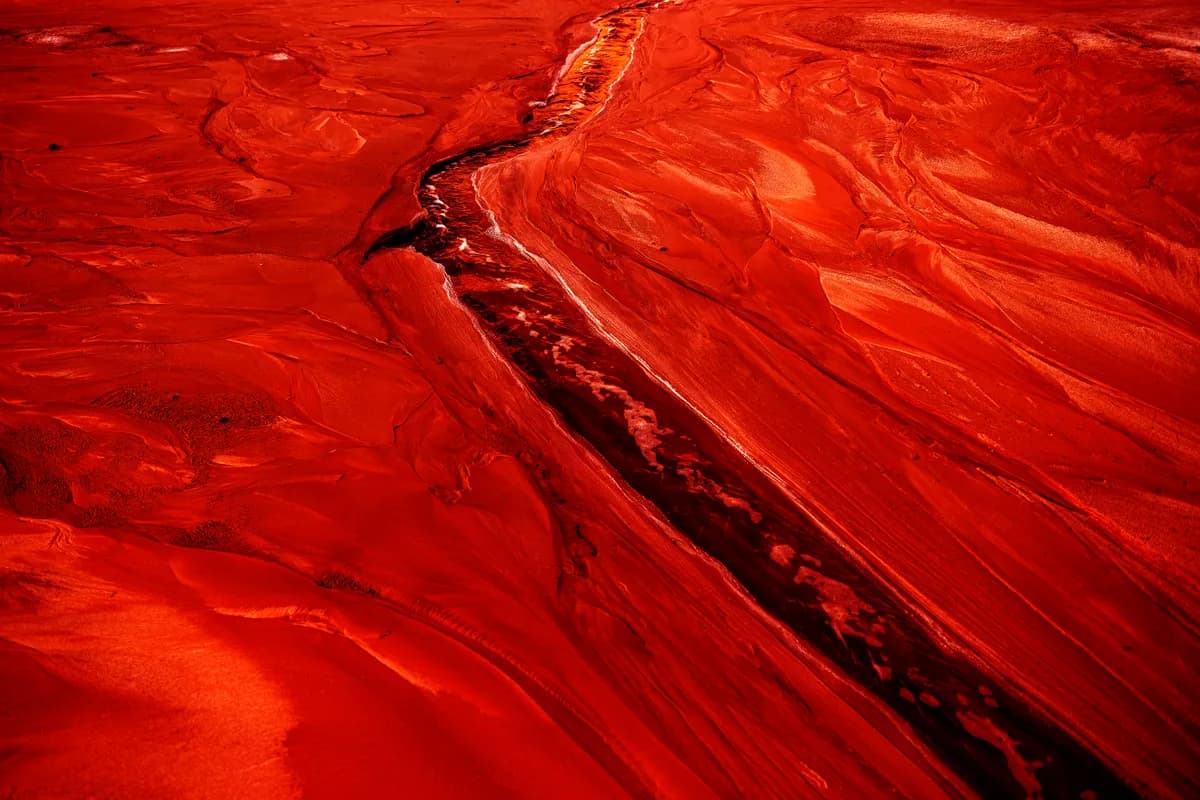
The exhibition first encounters transformation through a material that has recurred throughout Nguyen Phuong Linh ' s practice for nearly a decade. Printed on translucent PVC, landscapes gradually relinquish the certainty of place, drifting towards the textures of flesh, bodily fluids and internal organs. Saturated in red upon red, the immersive installation engulfs the viewer.
Within this space, the distinction between geography and the body becomes increasingly difficult to discern. Not all transformations depend upon material remain tied to place or the body. Some persist through images that resist waking consciousness altogether.
Emerging from images that linger after the mind stirs from sleep, Do Thanh Lang's paintings resist narrative while remaining emotionally poignant. Built through successive layers of acrylic, resin and translucent mediums, forms repeatedly surface and dissolve, allowing the paintings to extend the unstable logic of dreams beyond the moment of waking. Persistence assumes another form in Nadège David 's paintings.
Here, persistence lies not in return but in perpetual mutation. Dense constellations of flowers, roots and bodily forms organize themselves around unexpected symmetries while seemingly stable identities. Echoes of Northern Renaissance and Baroque grotesques surface not as quotation, but as ways of imagining bodies that exist in constant states of becoming.
Human, vegetal and animal forms merge into speculative ecologies where strange anatomies seem less invented than evolved. Continuity resides not in permanence, but in an endless act of evolution, where life persists through its capacity to reorganize, adapt and generate new forms. Repetition offers another way for life to continue.
In Jacqueline Lam's life, 88 drawings on Dó paper unfold through the repeated inscription of the Chinese characters 木 (tree) and 林 (forest). The same calligraphic brush is used across all 88 works where growth emerges gradually. Through the accumulation of repeated gestures, each mark quietly carries traces of the last.
Translation and fragmentation offer parallel ways through which artworks exceed the circumstances of their making. In Linh San 's work, stories originated from conversations with women in Nishinari, Osaka pass between Japanese, English and Vietnamese before finding another language altogether: the notation of knitting charts. Translation here does not seek fidelity but opens the possibility that meaning may continue exactly because it remains capable of becoming something else.
Across 12 moons, this same movement unfolds spatially. Individual porcelain moons remain utterly yet inseparable from the constellation to which they belong, suggesting that continuity may be carried not through permanence or completeness, but through relationships that persist across distance. Elsewhere, continuity is achieved not through preservation but through reconstruction in the work of Ngo Dinh Bao Chau.
Existing wooden structures are neither preserved nor discarded but reassembled into a new spatial proposition that continues to carry traces of its previous incarnation Silhouette of Mirage , originally demonstrated at the Thang Long Imperial Citadel in Hanoi. Wrapped in translucent mesh that evokes both architecture and safety netting, the structures remain suspended between stability and drift, becoming an ongoing negotiation between memory and transformation. Viewers move through a space where absence becomes as tangible as presence, and where previous forms linger without ever being fully restored.
Across the exhibition, no work returns unchanged. Each continues differently, acquiring new forms, new relationships and new ways of being encountered. Rather than existing as self-contained objects, the works remain open to circumstances that continuously reshape what they are capable of becoming.
What remains open is whether an artwork can ever be fully encountered at all. Each exhibition becomes another moment within a much longer conversation — one that neither begins nor ends within the walls of the gallery, but continues through memory, movement, reinterpretation and return. Inside the Landscape — Nguyen Phuong Linh At the far end of the second floor, let that begin from within.
In the back room, five translucent PVC works hang, fold and hover in space, their red surfaces carrying transformed landscapes that gradually slip towards flesh, blood and internal tissue. One lies on the floor, lifted into a taut, almost anatomical form, while the others float freely between wall, ceiling and air.
Seen as a whole, they feel less like individual works than fragments of a body whose interior has somehow been turned inside out. The installation can be encountered as a point of arrival, but also as a passage back outwards, as though the exhibition has led the viewer into the interior of a body only to release them again.